You wake up.
Answer a few emails.
Finish something for work.
Make a phone call you have been delaying.
Do laundry.
Buy groceries.
Clean the kitchen.
Handle one annoying little problem.
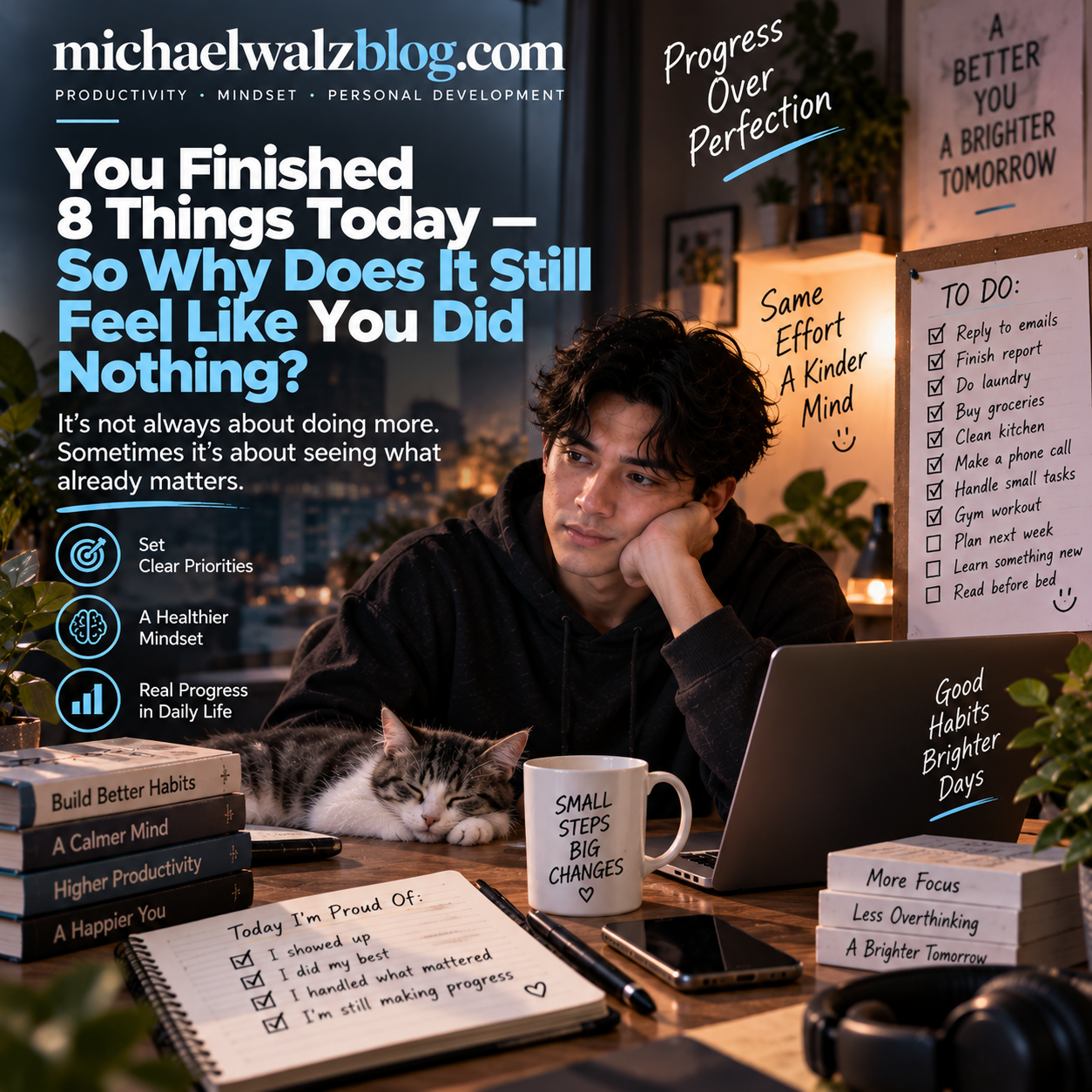
By evening, you have actually done quite a lot.
Then you look at your to-do list.
Three things are still unchecked.
And somehow your brain concludes:
“I barely got anything done today.”
Wait.
What?
Eight things completed.
Three unfinished.
Yet the unfinished tasks seem to matter more than everything you already accomplished.
This is one reason learning how to stop feeling unproductive is not always about becoming more efficient.
Sometimes the problem is the way we measure a “successful” day.
Your To-Do List Has No Natural Ending
Think about a normal to-do list.
Finish report.
Reply to messages.
Clean apartment.
Schedule appointment.
Exercise.
Order something.
Research something.
Pay bill.
Call someone.
Fix that thing.
Then, while completing those tasks, new ones appear.
Replying to an email creates another email.
Cleaning reminds you that you need detergent.
Going to the gym reminds you to buy groceries.
Finishing one project reveals the next project.
The list regenerates itself.
If your definition of productivity is “everything is finished,” you have created a game that is almost impossible to win.
We Notice What Is Missing
Imagine a checklist:
- Done
- Done
- Done
- Done
- Done
- Done
- Not done
Which item catches your attention?
Probably the last one.
Our minds are good at noticing incomplete things.
That can be useful.
It helps us remember responsibilities.
But it can also create the strange feeling that unfinished work cancels completed work.
It doesn’t.
Being Busy and Being Productive Are Different
A full day can feel productive because there was constant movement.
Emails.
Meetings.
Notifications.
Calls.
Documents.
Messages.
Tasks.
No empty space.
Then you finally stop and ask:
“What important thing actually moved forward?”
Sometimes the answer is uncomfortable.
Busyness measures activity.
Productivity should probably measure progress.
Those are not always the same thing.
One Important Task Can Matter More Than Ten Tiny Ones
Suppose today you:
answered seven emails,
organized your desktop,
updated your calendar,
cleaned your inbox,
and renamed some folders.
That’s five completed tasks.
Another person spent three hours finishing one important proposal.
Their checklist:
One task completed.
Who had the more productive day?
Counting tasks alone cannot tell us.
Tasks have different value.
Stop Giving Every Task Equal Weight
“Buy toothpaste” and “finish quarterly strategy” should not occupy the same mental category just because both appear as one line on a list.
Try separating tasks into:
Important
Necessary
Optional
Now your day becomes easier to evaluate.
Maybe you completed:
one important task,
three necessary tasks,
and ignored five optional ones.
That could be an excellent day.
Choose a Daily Win
Before the day gets noisy, ask:
“If I complete one thing today, what would make this day feel worthwhile?”
Not ten things.
One.
Maybe it is:
finishing a proposal,
going to the gym,
having an important conversation,
studying for an hour,
or completing a difficult piece of work.
That becomes your daily win.
Everything else can still matter.
But the day now has a clear center.
Your Most Important Task Should Not Always Wait Until “Later”
A common schedule looks like this:
9:00 — check email.
9:30 — messages.
10:00 — small task.
10:30 — meeting.
11:30 — another small task.
Lunch.
More messages.
Another meeting.
Suddenly it is 4:30 PM.
Now you finally begin the thing that actually required concentration.
And your brain is tired.
When possible, protect some of your better energy for work that matters.
Productivity Is Also About Energy
Two hours are not always equal.
Your brain at 10 AM may not work like your brain at 10 PM.
Notice when you tend to have the best:
focus,
creativity,
patience,
and mental energy.
Then try placing demanding work inside those periods.
Use lower-energy periods for simpler tasks.
This is often more realistic than forcing every hour to perform identically.
Stop Planning for Your Imaginary Perfect Self
Your Sunday-night planning version of you is incredibly ambitious.
Apparently Monday-you will:
wake up at 5:30,
exercise,
journal,
read,
work eight hours,
cook,
study,
clean,
answer everyone,
and somehow still have a relaxing evening.
Monday-you would like to file a complaint.
Plans often fail because we schedule for an ideal version of ourselves with:
perfect energy,
zero interruptions,
zero traffic,
zero unexpected problems,
and apparently no need to stare at the wall occasionally.
Plan for the human version.
Leave Empty Space in the Day
If your calendar has eight available hours, do not automatically schedule eight hours of tasks.
Life creates friction.
Things take longer.
People call.
Software breaks.
You need food.
Your concentration drops.
A 100% full plan becomes late the moment anything unexpected happens.
Some empty space is not wasted time.
It is capacity.
Estimate How Long Things Actually Take
“This will take 20 minutes.”
One hour later…
Still working.
We often estimate only the main task.
But tasks include:
opening files,
finding information,
making decisions,
waiting,
reviewing,
fixing mistakes,
and switching context.
Start comparing your estimates with reality.
You may discover that your “lazy day” was simply an impossible schedule.
Count Invisible Work
Some work does not produce a satisfying checkbox.
Thinking.
Planning.
Researching.
Learning.
Helping someone.
Solving a confusing problem.
Making a difficult decision.
Preparing for future work.
These activities can consume real mental energy even when there is no obvious finished product.
Do not automatically classify them as “doing nothing.”
Emotional Tasks Count Too
Some days include:
a difficult conversation,
family responsibilities,
unexpected bad news,
supporting someone,
or dealing with personal stress.
Then you wonder why your productivity dropped.
Because you are not a machine operating in an emotional vacuum.
Context matters.
A realistic evaluation of your day should include what the day actually required from you.
Rest Is Not a Failed Version of Work
This one causes a lot of guilt.
You sit down for an hour.
Watch something.
Take a nap.
Play a game.
Walk.
Do absolutely nothing useful.
Then the internal productivity manager appears:
“We could have been accomplishing something.”
But humans need recovery.
The goal of rest is not secretly producing more output every second.
Sometimes rest is just rest.
Stop Trying to Optimize Every Hobby
You start running.
Soon you need:
a training plan,
pace goals,
weekly mileage,
performance tracking.
You start reading.
Now:
50 books this year.
You cook.
Suddenly:
meal-prep optimization system.
You journal.
Now there is a 30-day journaling streak.
It is possible to turn every enjoyable activity into another performance metric.
Not everything needs a KPI.
A Hobby Can Be Badly Done
Paint badly.
Sing badly.
Play a game without becoming competitive.
Cook something unnecessarily complicated.
Read slowly.
Walk without tracking the distance.
There is something refreshing about an activity that does not need to become evidence of self-improvement.
Your Phone Can Create Fake Productivity
You pick up your phone to answer one useful message.
Then:
email,
calendar,
weather,
another message,
news,
social media.
Twenty-five minutes disappear.
But because the first action was “productive,” the entire session can feel vaguely justified.
Be careful with tools that mix work and entertainment in the same device.
Switching Tasks Has a Cost
Write for five minutes.
Check message.
Return.
Email arrives.
Reply.
Return.
Someone asks something.
Answer.
Return.
Your day can contain six hours of work without containing one uninterrupted hour.
Constant switching makes concentration harder.
When possible, group similar tasks.
For example:
answer messages together,
make calls together,
handle administrative work together.
This reduces some of the mental restarting.
Try a “Done List”
At the end of the day, write down what you actually completed.
Not what you hoped to complete.
What happened?
Maybe:
finished client work,
exercised,
bought groceries,
called parents,
paid bills,
cleaned apartment,
prepared tomorrow’s work.
Suddenly the day looks different.
A done list provides evidence against the vague feeling:
“I did nothing.”
Include Things That Were Not Planned
Maybe fixing the broken printer was not on your list.
But it took 45 minutes.
Maybe an unexpected meeting took an hour.
Maybe you helped a coworker solve a problem.
Those activities used time.
Ignoring them creates an inaccurate picture of your day.
Review Weeks, Not Just Days
Some days are naturally uneven.
Monday may be highly productive.
Tuesday gets destroyed by meetings.
Wednesday becomes your best focus day.
Thursday something unexpected happens.
Friday is mostly administration.
Looking at each day individually can make normal variation feel like failure.
Weekly progress often tells a better story.
Ask:
What meaningful things moved forward this week?
That question is usually more useful than:
Was every single day perfect?
Stop Comparing Your Tuesday to Someone Else’s Highlight Reel
Someone posts:
5 AM workout.
Healthy breakfast.
Three hours of deep work.
Successful business.
Perfect apartment.
Evening reading.
You look at your own Tuesday:
woke up late,
forgot laundry,
ate cereal,
answered emails,
felt tired.
Comparison complete.
But you are comparing your entire ordinary day with selected moments from somebody else’s life.
That data is useless.
You Don’t Know Their Support System
Visible productivity may be supported by invisible advantages.
Maybe someone has:
a cleaner,
assistant,
partner handling household tasks,
short commute,
flexible job,
childcare,
or fewer responsibilities.
That does not invalidate their accomplishments.
It simply means copying their routine without copying their circumstances may not work.
A Routine Should Fit Your Life
The best productivity system is not necessarily the one with:
the prettiest planner,
most complicated app,
or longest morning routine.
It is the one you can realistically use.
If a simple paper list works?
Use it.
If calendar blocks work?
Great.
If three priorities in your phone notes are enough?
Also fine.
A productivity system should reduce mental load.
Not become another hobby you need to maintain.
Beware of Productivity Procrastination
You need to start working.
Instead, you decide your task system needs improvement.
So you:
download a new app,
create categories,
choose icons,
reorganize projects,
watch productivity videos,
build a dashboard.
Three hours later, your productivity system is beautiful.
The actual work?
Still waiting.
Organizing work can become a sophisticated way of avoiding work.
Ask What You Are Avoiding
If one task keeps moving from:
Monday
to Tuesday
to Wednesday
to next week,
stop rewriting it.
Ask:
Why am I avoiding this?
Maybe it is:
unclear,
boring,
difficult,
emotionally uncomfortable,
too large,
or dependent on information you do not have.
The solution depends on the reason.
Make Vague Tasks Smaller
“Work on website.”
Too vague.
What does that mean?
Try:
write homepage introduction,
resize five images,
fix contact form,
review mobile navigation.
Now your brain can see where to begin.
Clarity reduces resistance.
Define the Next Physical Action
For difficult tasks, ask:
“What is the next thing I can physically do?”
Not:
“Build business strategy.”
Maybe:
“Open last quarter’s sales report.”
Not:
“Get healthy.”
Maybe:
“Put gym clothes beside the bed.”
Progress often starts with something embarrassingly small.
That’s fine.
Stop Adding Tasks Without Removing Any
New responsibility arrives.
You add it.
Another arrives.
Add.
New goal?
Add.
New habit?
Add.
Eventually your schedule becomes a museum of every ambition you have ever had.
When adding something significant, ask:
What am I reducing, postponing, or removing?
Time is finite even when motivation temporarily pretends otherwise.
Create a “Not Now” List
Some ideas are good.
Just not now.
Instead of forcing every interesting goal into your current week, keep a separate list.
Courses.
Projects.
Books.
Skills.
Business ideas.
Places.
Future improvements.
They are not abandoned.
They are simply not competing with today’s priorities.
Productivity Needs Subtraction
We often ask:
“What should I do?”
Try asking:
“What can I stop doing?”
Maybe:
a recurring meeting,
manual process,
unnecessary report,
notification,
commitment,
or personal rule
no longer provides enough value.
Removing one repeated task can create more time than optimizing twenty small ones.
Define “Enough” Before You Start
This is especially useful for people who keep improving things forever.
Before beginning, decide:
What does finished look like?
A report may need to be:
accurate,
clear,
and submitted.
It may not need to become the greatest report in corporate history.
Without a finish line, perfectionism can consume unlimited time.
Some Days Are Maintenance Days
Not every day moves your life dramatically forward.
Some days are for:
laundry,
groceries,
administration,
cleaning,
appointments,
emails,
maintenance.
These days can feel unimpressive.
But ordinary life collapses surprisingly quickly when maintenance disappears.
Keeping things functioning is also useful work.
Your Worth Is Not Your Output
This is where productivity advice can become unhealthy.
A productive day may feel satisfying.
Great.
But completing more tasks does not make someone more valuable as a person.
And having a slow day does not reduce your worth.
Productivity is a tool for managing work and goals.
It is a terrible system for measuring human value.
Try the Three-Line Evening Review
Before bed, write:
What did I finish?
What mattered today?
What can wait until tomorrow?
Three questions.
That is enough.
The final question is especially important.
Some tasks genuinely can wait.
Give them permission to.
End the Workday Deliberately
Remote work and smartphones make work feel endless.
There is always:
one more email,
one more edit,
one more notification.
Create a small shutdown ritual.
Maybe:
review tomorrow’s priorities,
close work tabs,
clear your desk,
write unfinished tasks down,
then stop.
Your brain needs a signal that work has ended.
Tomorrow Does Not Need a Perfect Version of You
You do not need to wake up transformed.
You need a realistic next step.
Maybe tomorrow you will:
finish one important task,
do three necessary things,
leave several optional things unfinished,
and rest afterward.
That can be enough.
FAQ
Why do I feel unproductive even when I accomplish things?
People often focus more strongly on unfinished tasks than completed ones. Unrealistic plans, comparing tasks by quantity instead of importance, and ignoring invisible work can also make productive days feel inadequate.
Is a long to-do list bad?
Not necessarily. The problem appears when every item is treated as equally important or when completing the entire list becomes the only definition of a successful day.
How many priorities should I have each day?
There is no universal number, but choosing one major priority plus a few necessary tasks can make daily planning more realistic than treating a long list as equally urgent.
What is a done list?
A done list records tasks and meaningful activities you actually completed during the day, including unexpected work that may not have appeared on your original plan.
Is resting considered productive?
Rest does not need to be justified as productivity. Recovery is a normal human need and can support sustainable performance, but leisure can also simply be valuable on its own.
How can I stop feeling guilty when I don’t finish everything?
Set realistic priorities, define what “enough” looks like before the day begins, acknowledge completed and unexpected work, and deliberately move nonessential tasks to another day when necessary.
Conclusion
Maybe today you did not finish everything.
Good news:
almost nobody does.
There will always be another:
email,
task,
idea,
project,
chore,
or improvement waiting somewhere.
If your brain only looks at what remains, even an objectively productive day can feel like failure.
So tonight, before judging yourself by the three unchecked boxes, look at the eight you completed.
Then ask a better question.
Not:
“Did I finish everything?”
Ask:
“Did I move something important forward?”
If the answer is yes, the day probably counted for more than you think.