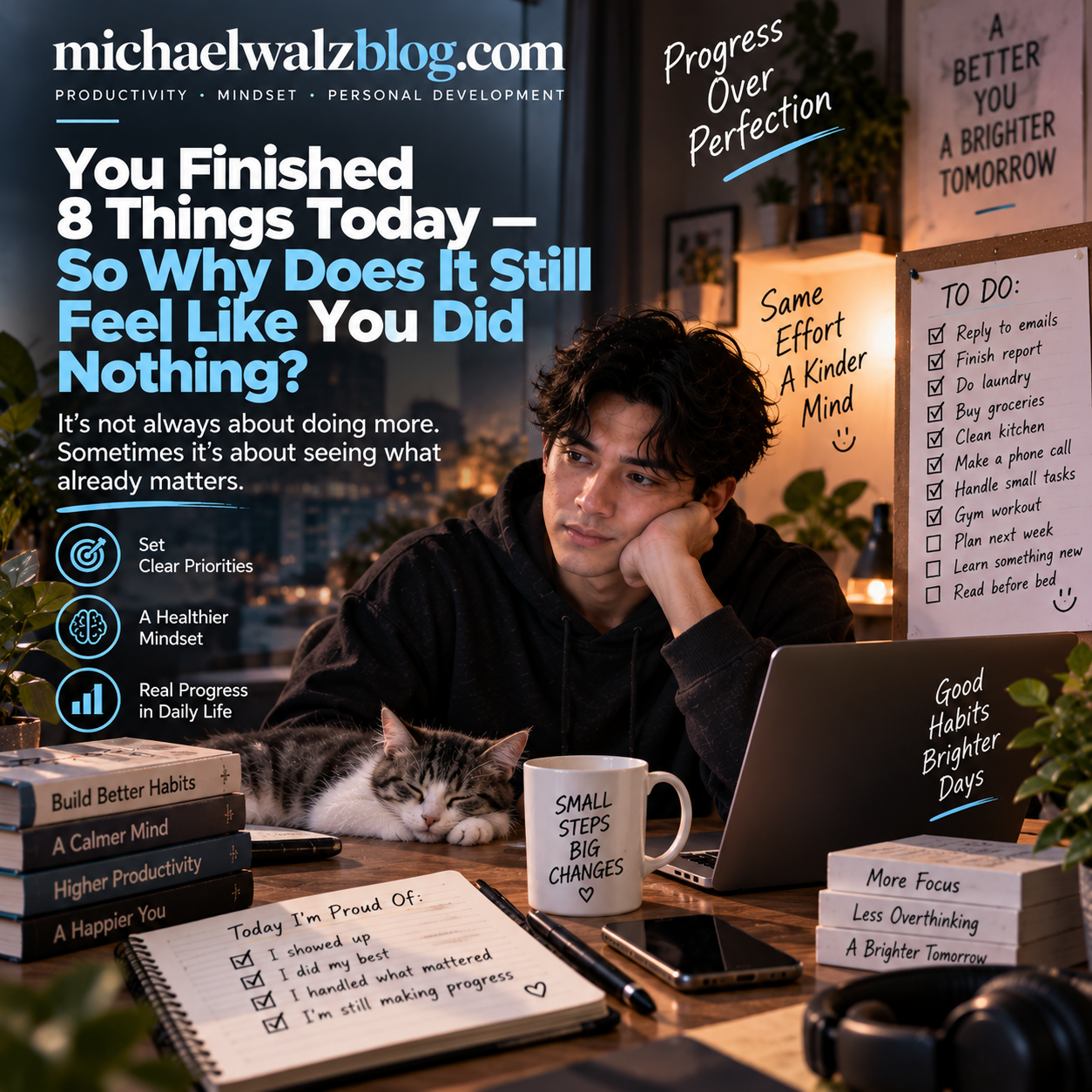
You answered the emails.
Replied to the messages.
Joined the meetings.
Updated the spreadsheet.
Moved a few tasks around.
Checked something quickly.
Fixed something someone else needed.
Opened twelve browser tabs.
Closed eight of them.
Added three new things to your to-do list.
By the end of the day, you were tired enough to prove that you had worked.
Then you looked at the one thing you actually wanted to move forward.
The proposal.
The portfolio.
The business idea.
The difficult report.
The application.
The book.
The project that could genuinely change something.
Still sitting there.
Almost exactly where it was yesterday.
This is one of the strangest experiences of modern work.
A day can be completely full without being particularly productive.
Activity creates the sensation of movement.
Notifications create urgency.
Completed small tasks create satisfaction.
But none of those things automatically mean progress.
That is where meaningful productivity becomes useful.
It asks a different question.
Not:
“How much did I do today?”
But:
“What became meaningfully different because of what I did today?”
A Full Calendar Can Hide an Empty Day
Busyness is easy to measure.
Seven meetings.
Forty emails.
Twenty completed tasks.
Three phone calls.
A calendar with almost no white space.
Productivity is harder.
Did the important project move?
Was a meaningful decision made?
Did something valuable get created?
Was a recurring problem permanently solved?
Did today’s work make tomorrow easier?
Those questions are less visually impressive.
But they reveal more.
A person can spend eight hours responding to incoming demands without creating meaningful progress on their own priorities.
The day was busy.
That does not mean it was wasted.
Some reactive work is necessary.
But if every day operates this way, important work gets pushed indefinitely into a future that never arrives.
Small Tasks Feel Productive Because They Finish Quickly
There is something satisfying about completion.
Send email.
Done.
Book appointment.
Done.
Update document.
Done.
Reply to message.
Done.
The brain gets frequent evidence of progress.
A difficult project behaves differently.
“Develop a new business strategy” does not disappear from the list after seven minutes.
Neither does:
Write a book.
Change careers.
Build a portfolio.
Learn a difficult skill.
Launch a product.
Complete a major analysis.
These projects can absorb hours without providing the emotional reward of a completed checkbox.
So when we feel uncertain or tired, small tasks become attractive.
They offer closure.
The To-Do List Can Become a Hiding Place
To-do lists are useful.
But they can also hide priorities.
Imagine a list containing:
Reply to Daniel.
Order printer paper.
Schedule dentist appointment.
Review subscription.
Rename folder.
Finish client proposal.
Update password.
Buy groceries.
Confirm Friday meeting.
The proposal is the most important professional task.
But visually, it is just one line among nine.
If you complete the other eight, the list looks successful.
Eight out of nine.
Almost perfect.
Except the unfinished task may have mattered more than everything else combined.
A flat list treats unequal tasks as though they have equal value.
Real life does not.
Not Every Completed Task Deserves the Same Credit
Suppose you need to prepare a presentation for an important meeting tomorrow.
Instead, you spend the afternoon reorganizing your files.
File organization is useful.
But usefulness is contextual.
At that moment, preparing the presentation has greater consequence.
This is why meaningful productivity cannot be reduced to task completion.
The value of a task depends partly on what it enables, prevents, or changes.
Ten low-impact tasks do not automatically outweigh one high-impact task.
Ask What Actually Matters Before Opening Your Inbox
Many people begin the workday by opening communication.
Email.
Slack.
Teams.
WhatsApp.
Notifications.
Immediately, other people’s priorities enter the room.
Someone needs an answer.
Someone has a question.
Someone wants feedback.
Someone scheduled something.
Someone marked something urgent.
An hour later, you are working.
But you may no longer be working on what you originally intended.
This is not an argument for ignoring communication.
It is an argument for knowing your own priorities before external demands start competing for attention.
Choose One Result That Would Make the Day Count
Before the day becomes noisy, ask:
“If only one meaningful thing moved forward today, what should it be?”
Not ten things.
One.
Maybe:
Finish the first draft.
Send the proposal.
Complete the analysis.
Make the difficult decision.
Apply for the position.
Build the prototype.
Have the important conversation.
This does not mean you ignore everything else.
It gives the day a center.
When interruptions appear, you know what you are trying to protect.
Important Work Often Does Not Feel Urgent
Urgent tasks announce themselves.
Important tasks often wait quietly.
The invoice due today has a deadline.
The customer complaint demands attention.
The meeting starts in five minutes.
The notification appears now.
But developing a valuable skill?
No notification.
Improving a broken process?
Maybe no deadline.
Planning your next career move?
Nobody sends a reminder.
Writing something meaningful?
It can wait.
And because it can wait, it often does.
For months.
Sometimes years.
Urgency Is Powerful Because It Removes Choice
A deadline at 4 p.m. creates clarity.
You know what needs attention.
Long-term work rarely provides that clarity automatically.
There is no alarm saying:
“You have postponed building your portfolio for 117 days.”
Nothing flashes red because you have not spent time thinking about your career.
So if something matters but lacks external urgency, you may need to create intentional space for it.
Otherwise urgent work will continually consume the calendar.
Put Important Work on the Calendar Before the Calendar Fills
A task list says what.
A calendar says when.
This distinction matters.
“Work on portfolio” can remain on a list for weeks.
“Tuesday, 9:00–10:30: finish two portfolio case studies” has a place.
Time blocking does not guarantee execution.
Meetings move.
Emergencies happen.
Energy changes.
But assigning time forces a practical question:
Where will this work actually fit?
If the answer is nowhere, the priority currently exists only in theory.
Protect the First Useful Hour You Can Realistically Control
Productivity advice often says to protect the morning.
That works for some people.
Not everyone controls their morning.
Maybe you have children.
A commute.
Customer support responsibilities.
A daily meeting.
A different energy rhythm.
Instead, identify the first substantial block of time you can reasonably protect.
Maybe 8 a.m.
Maybe 11 a.m.
Maybe after lunch.
Maybe evening.
The principle matters more than the clock.
Give important work a period where it does not have to compete with every minor demand.
Deep Work Does Not Require Four Perfect Hours
People sometimes imagine focused work as an enormous uninterrupted session.
Quiet office.
Phone off.
Three hours.
Perfect concentration.
That can be wonderful.
It is not always necessary.
Forty-five genuinely focused minutes can move an important project substantially.
The problem is often not that we lack four hours.
It is that the available forty-five minutes disappear into email, browsing, preparation, and switching between tasks.
Protecting smaller blocks consistently can be more realistic than waiting for the perfect afternoon.
Starting Is Often Harder Than Continuing
A difficult task sits there.
You know what it is.
You know it matters.
Yet somehow you keep doing other things.
Often the resistance is concentrated at the beginning.
The document is blank.
The project feels undefined.
You do not know the first sentence.
You are uncertain whether the approach is correct.
Once movement begins, the task may become easier.
So reduce the size of the start.
Not:
“Finish the presentation.”
Try:
“Create the slide headings.”
Not:
“Write the report.”
Try:
“Draft the opening section.”
A clear entry point reduces the psychological size of the task.
Make the Next Action Visible
“Work on business” is not a task.
Neither is:
Improve website.
Get healthier.
Study marketing.
Fix finances.
These are directions.
A useful next action is concrete.
List the five pages that need rewriting.
Call the accountant.
Read chapter three and take notes.
Draft the pricing section.
Walk for twenty minutes after lunch.
When procrastination appears, vague tasks create more room for avoidance because we first have to decide what “working on it” means.
Clarity reduces that extra decision.
Preparation Can Quietly Become Procrastination
Research feels productive.
Planning feels productive.
Organizing feels productive.
Buying tools feels productive.
Watching tutorials feels productive.
And sometimes all of those things are genuinely necessary.
But preparation can continue long after we have enough information to begin.
One more video.
One more article.
One more template.
One more productivity app.
Eventually preparation becomes a sophisticated way of avoiding exposure to actual work.
The question becomes:
Do I need more information, or am I uncomfortable starting?
The Perfect System Will Not Rescue an Avoided Task
New planner.
New app.
New notebook.
New workspace.
New productivity method.
For a few days, everything feels different.
Then the same difficult task is still difficult.
Tools can help.
But tools cannot remove every form of resistance.
If the problem is fear of producing bad work, a prettier task manager will not solve it.
If the problem is uncertainty, you may need to make a decision.
If the problem is exhaustion, you may need recovery.
Diagnose the friction before replacing the system.
Productivity Problems Are Not Always Time Problems
“I don’t have enough time.”
Sometimes true.
But examine the day.
Perhaps time exists in fragments.
Twenty minutes here.
Forty minutes there.
An hour lost to unnecessary meetings.
Thirty minutes of scrolling after a difficult task.
Another thirty minutes spent deciding what to do.
The issue may be attention, energy, clarity, boundaries, or fragmentation rather than raw hours.
Different problems need different solutions.
A time-management technique cannot fix every productivity problem.
Attention Is a Resource, Not Just Time
Two hours of fragmented attention can produce less than forty minutes of focused work.
Message.
Task.
Notification.
Task.
Email.
Task.
Quick search.
Task.
Every switch requires mental reorientation.
Even when interruptions are small, they can break continuity.
This matters especially for work requiring reasoning, writing, design, planning, or complex decisions.
Protecting attention can therefore be just as important as protecting calendar time.
Turn Off Notifications That Do Not Deserve Immediate Access to You
Not every notification represents something urgent.
Promotions.
Social updates.
Group messages.
App suggestions.
News alerts.
Random reminders.
Each one makes a tiny claim on attention.
You do not need to eliminate notifications completely.
Decide which categories genuinely require immediate awareness.
Let the rest wait until you intentionally check them.
Your phone should not automatically determine what your brain thinks about next.
Check Communication Deliberately Instead of Reflexively
There is a difference between checking email because it is time to process email and checking because a difficult paragraph made you uncomfortable.
The second behavior often looks like work.
That makes it especially sneaky.
You are still inside a work application.
Still responding.
Still technically productive.
But you have abandoned the harder task.
Creating deliberate communication windows can help separate necessary responsiveness from automatic escape.
Fast Replies Can Create More Fast Replies
If you respond to every message within thirty seconds, people learn something.
You are always available.
They begin expecting immediate answers.
More questions arrive through direct messages instead of being solved independently.
Your responsiveness gradually creates the environment that requires more responsiveness.
Not every workplace allows slow replies.
But where possible, avoid creating unnecessary expectations of instant access.
Responsiveness should serve the work.
Not consume it.
Meetings Should Have a Reason to Exist
Some meetings are essential.
Complex decisions.
Sensitive conversations.
Collaborative problem-solving.
Situations where rapid back-and-forth saves time.
Others exist because they have always existed.
Weekly sync.
Status meeting.
Another status meeting.
Preparation for the status meeting.
Meeting to discuss what happened in another meeting.
Periodically ask:
What does this meeting produce?
A decision?
Alignment?
Ideas?
A plan?
If nobody can answer, the calendar may be protecting a ritual rather than useful work.
A Status Update Does Not Always Need a Meeting
If everyone simply reports what they did, a written update may work.
This has another benefit.
People can read it when convenient.
Information becomes searchable.
The meeting slot becomes available for work that requires real-time discussion.
Again, not every status meeting is useless.
The point is to match communication format to purpose.
Synchronous time is expensive because everyone must spend it simultaneously.
Use it where simultaneity creates value.
Stop Measuring Work by How Exhausted You Feel
There is a cultural tendency to treat exhaustion as evidence.
If you are tired, you must have worked hard.
If the day felt easy, perhaps you did not do enough.
But effective work can sometimes look surprisingly calm.
One clear priority.
A protected block.
A useful decision.
A short meeting.
A few necessary messages.
Done.
Meanwhile, a chaotic day can be exhausting precisely because nothing was organized.
Stress is not a productivity metric.
Hard Work and Useful Work Are Not Always the Same
You can spend hours perfecting a document nobody needs.
You can build a complex spreadsheet when a simple decision would solve the problem.
You can manually repeat a process that should have been automated.
Effort has value.
But effort should not be confused with impact.
Before investing heavily, ask:
If I complete this perfectly, what changes?
Sometimes that question reveals that the task deserves less effort than we were about to give it.
Perfectionism Can Turn High-Value Work Into an Infinite Project
Important projects often attract perfectionism.
Because they matter, we want them to be excellent.
So we keep editing.
Another revision.
Another adjustment.
Another comparison.
Eventually the pursuit of quality prevents completion.
Define “done” before starting.
What requirements must be met?
What level of quality is appropriate?
Who needs to approve it?
What would make another revision genuinely worthwhile?
Standards protect quality.
Undefined perfection keeps moving the finish line.
Different Tasks Deserve Different Quality Standards
A public report and an internal note should not receive identical polish.
A major client proposal and a routine email should not consume equal attention.
A prototype does not need production-level perfection.
A brainstorming document can be messy.
One productivity skill is matching effort to consequence.
Over-polishing low-impact work steals time from high-impact work.
“Good enough” is not laziness when the context genuinely requires only good enough.
Define the Purpose Before You Begin
Why does this task exist?
A presentation might exist to secure approval.
A report might exist to support a decision.
A meeting might exist to resolve one disagreement.
A landing page might exist to explain an offer clearly.
Once the purpose is explicit, unnecessary work becomes easier to identify.
Do we need fifteen slides?
Do we need this section?
Do we need another meeting?
Do we need three design variations?
Purpose acts as a filter.
Some Tasks Should Be Deleted, Not Optimized
Productivity culture often assumes every task deserves a better process.
Not true.
Some work should disappear.
A report nobody reads.
A recurring meeting nobody needs.
A manual step left over from an old system.
A metric nobody uses.
An approval that adds no value.
Before asking how to do something faster, ask whether it still needs to exist.
The fastest unnecessary task is the one you stop doing.
Automation Comes After Understanding
There is a temptation to automate immediately.
But automating a bad process simply makes the bad process happen faster.
First understand:
Why does this process exist?
Which steps create value?
Which are redundant?
Where do errors happen?
What exceptions require judgment?
Simplify first.
Then automate the stable, repetitive parts where doing so genuinely saves effort.
Repeated Tasks Are Signals
If you perform the same small action every day, notice it.
Copying data.
Renaming files.
Sending identical instructions.
Answering the same question.
Preparing the same report.
These repetitions may indicate an opportunity for:
A template.
Checklist.
Shortcut.
Automation.
Documentation.
Delegation.
A few minutes saved once is trivial.
A few minutes removed from a task repeated hundreds of times can become meaningful.
Templates Preserve Attention for the Part That Actually Requires Thinking
Starting from zero creates unnecessary cognitive work.
A good template can provide:
Structure.
Required fields.
Standard language.
Common steps.
Formatting.
Then your attention goes toward the unique part of the task.
Templates are particularly valuable for recurring work such as proposals, meeting notes, reports, project briefs, or reviews.
They reduce reinvention without eliminating judgment.
Batch Similar Small Tasks When Possible
Tiny tasks are not always the problem.
Constant switching is.
If you have several administrative tasks, doing them together can reduce repeated context changes.
Process invoices.
Then messages.
Then scheduling.
Then return to deeper work.
This is not a rigid rule.
Some jobs require continuous responsiveness.
But where flexibility exists, batching can make fragmented work less dominant.
Your Energy Has a Pattern Even If Your Calendar Pretends It Does Not
Most calendars treat 9:00 and 15:00 as identical rectangles.
Your brain may disagree.
Perhaps you think clearly in the morning.
Perhaps afternoon is better.
Perhaps you become creative late at night.
Observe.
When is analytical work easiest?
When does concentration drop?
When do you prefer communication?
When does exercise feel realistic?
Then place tasks accordingly when possible.
Time management improves when it becomes energy-aware.
Use Low-Energy Periods for Lower-Cognitive Work
Not every task needs peak concentration.
Scheduling.
Basic administration.
Organizing files.
Routine email.
Simple updates.
Expense processing.
These can fit periods when mental energy is lower.
Save your best available attention for tasks that actually benefit from it.
Otherwise you may spend your sharpest hour clearing an inbox and attempt your hardest work when exhausted.
Breaks Are Not the Enemy of Productivity
The fantasy of productivity is continuous output.
Real concentration fluctuates.
Breaks can help prevent fatigue from turning into useless screen time.
The important distinction is between intentional recovery and accidental disappearance.
Five minutes away from the screen can be restorative.
Opening social media “for a minute” and returning forty-five minutes later may not be.
Choose breaks that actually feel like breaks.
Rest Should Not Need to Be Earned by Collapse
If rest only happens when you are completely exhausted, recovery begins too late.
Sleep.
Meals.
Movement.
Social connection.
Unstructured time.
These are not prizes for finishing every task.
They are part of maintaining the capacity to continue doing useful work.
Meaningful productivity should support a sustainable life.
A system that produces excellent output for three weeks and burnout afterward is not especially effective.
Overwork Can Hide Prioritization Problems
Sometimes there truly is too much work.
Other times, everything has been treated as equally urgent.
Every request accepted.
Every meeting attended.
Every task polished.
Every message answered immediately.
Every opportunity pursued.
Working longer temporarily hides the absence of trade-offs.
Eventually there are not enough hours.
Prioritization requires deciding what will receive less attention.
That is uncomfortable.
It is also unavoidable.
Saying Yes Creates Future Work
A request may take five seconds to accept.
“Sure.”
The actual commitment might require five hours next week.
This gap makes overcommitment easy.
Before agreeing, ask what the yes actually contains.
Preparation?
Travel?
Follow-up?
Revision?
Ongoing maintenance?
Opportunity cost?
A calendar becomes overloaded one innocent yes at a time.
A Priority Means Something Else Receives Less
If you have twelve number-one priorities, you have no priorities.
Real prioritization creates hierarchy.
This matters more.
That matters less.
This happens now.
That waits.
This deserves excellence.
That needs adequacy.
This stays with me.
That gets delegated.
Without trade-offs, priority becomes a motivational word rather than a decision.
Use a “Not Now” List
Some ideas are good.
Just not now.
A course.
A side project.
A new business idea.
A book recommendation.
A redesign.
A skill.
Keeping everything active creates mental clutter.
Instead, maintain a place for worthwhile ideas that are deliberately inactive.
This lets you preserve them without pretending you currently have capacity for all of them.
“Not now” is different from “never.”
Finish More by Starting Less
Multiple open projects create hidden costs.
Each has context.
Files.
Decisions.
Next steps.
Deadlines.
Unfinished thoughts.
When too many projects remain active, attention becomes diluted.
Consider limiting work in progress.
Finish something meaningful before activating another optional project.
This can feel slower because fewer things appear to be happening.
In practice, more things may actually reach completion.
Progress Often Looks Boring
The first day of a project feels exciting.
New folder.
New idea.
New plan.
The middle is different.
Revision.
Practice.
Debugging.
Repetition.
Waiting.
Small improvements.
This is where many worthwhile projects die.
Not because they became impossible.
Because they stopped feeling new.
Learning to tolerate the boring middle is a major productivity advantage.
Motivation Is Useful but Unreliable
Motivation rises and falls.
A system that only works when motivation is high will produce inconsistent results.
This is where stable contexts and repeated cues can help. Research on habit formation suggests that repeating behavior in stable contexts can strengthen automaticity and make execution less dependent on constant deliberate effort.
In practical terms, this means reducing the number of times you need to ask:
“Do I feel like doing this today?”
A recurring place, time, or preceding action can make starting more predictable.
Build a Start Ritual for Important Work
A ritual can be extremely small.
Close communication apps.
Fill water.
Open the project.
Write today’s target.
Set the phone away.
Begin.
Repeated in a similar context, a sequence like this can become a recognizable transition into focused work. Research on context stability supports the broader idea that stable cues and repeated behavior can strengthen habit automaticity. PubMed Central (PMC)
The ritual is not magic.
Its value is reducing ambiguity at the moment you need to begin.
Stop Waiting to Feel Ready
Readiness is seductive.
You will begin when you have more energy.
More information.
More confidence.
A better plan.
A quieter week.
Then another month passes.
Many projects create clarity through action.
You write the bad first paragraph.
Then understand the second.
You build the rough prototype.
Then discover what needs fixing.
You have the conversation.
Then know what the actual problem is.
Action often generates information that thinking alone cannot provide.
Make Bad First Versions Cheap
If the first attempt must be excellent, starting becomes dangerous.
So lower the stakes.
Draft.
Prototype.
Sketch.
Outline.
Test.
Create something deliberately incomplete.
The first version exists to make the problem visible.
Once something exists, you can improve it.
Perfectionism thrives in imagination because imaginary work has no flaws.
Real work does.
That is how improvement becomes possible.
Separate Creation From Evaluation
Writing while constantly judging every sentence is exhausting.
Generating ideas while rejecting them immediately produces little.
Sometimes it helps to separate modes.
First create.
Then review.
First brainstorm.
Then filter.
First draft.
Then edit.
This does not mean quality disappears.
It means evaluation happens at a stage where it is useful rather than interrupting every attempt to produce something.
Decide Tomorrow’s First Step Before Stopping Today
One of the easiest ways to reduce morning friction is to leave yourself an obvious entry point.
Before finishing:
Write the next action.
Leave the relevant document open or clearly named.
Note the unresolved question.
Prepare required materials.
Tomorrow, you do not need to reconstruct the entire project before beginning.
Yesterday-you already left instructions.
End the Day With a Short Review, Not a Trial
What moved?
What did not?
What became more important?
What can wait?
What is tomorrow’s first meaningful task?
This review does not need to become an elaborate journaling ritual.
Five minutes may be enough.
The purpose is orientation.
Not judging whether you were a good or bad person based on today’s output.
Review Outcomes, Not Just Hours
“I worked ten hours.”
Okay.
What changed?
Sometimes ten hours are necessary.
Sometimes three focused hours produce more meaningful progress.
Track outcomes where appropriate.
Draft completed.
Decision made.
Problem solved.
Milestone reached.
Customer issue resolved.
Process improved.
Hours describe input.
They do not automatically describe value.
Weekly Reviews Reveal What Daily Busyness Hides
Individual days are noisy.
A week reveals patterns.
Maybe you planned to spend five hours on a strategic project but spent zero.
Maybe meetings consumed twice what you expected.
Maybe Tuesday mornings consistently produced excellent work.
Maybe one recurring task caused repeated interruptions.
A weekly review lets you adjust the system rather than repeatedly experiencing the same problems.
Ask What Created the Most Value This Week
Not what consumed the most time.
What created value?
Maybe one conversation resolved a month-long issue.
One focused session completed the proposal.
One process change eliminated recurring work.
One hour of planning prevented several days of confusion.
These observations help you identify leverage.
Then you can deliberately create more room for similar work.
Ask What Created Work Without Creating Value
Some activities generate more activity.
A poorly structured meeting creates follow-up meetings.
An unclear email creates ten clarification messages.
A rushed decision creates rework.
An unnecessary report creates monthly maintenance.
Notice these loops.
Productivity improves not only by working faster but by reducing work that manufactures more work.
Rework Is a Hidden Productivity Tax
Doing something twice is expensive.
Sometimes rework is unavoidable.
Requirements change.
New information appears.
Experiments fail.
But repeated rework caused by unclear expectations can often be reduced.
Before beginning important work, clarify:
What is the outcome?
Who decides?
What constraints exist?
What does good look like?
When is it due?
A few minutes of alignment can save hours of revision.
Decision Delay Creates Invisible Queues
A project can appear inactive because one decision has not been made.
Which direction?
Which vendor?
Which concept?
Which price?
Who owns it?
While the decision waits, several people may be unable to proceed.
If you are responsible for a blocking decision, recognize its leverage.
Sometimes the most productive thing you can do is not produce anything.
It is decide.
Some Decisions Need a Deadline Too
We often give deadlines to tasks but not decisions.
So research continues indefinitely.
“I’ll think about it.”
For reversible or moderate-risk decisions, set a decision point.
By Thursday, choose.
By Friday, decline.
By next week, test option A.
A deadline prevents uncertainty from consuming unlimited attention.
Reversible Decisions Do Not Need Perfect Certainty
Some choices can be changed easily.
Try a different workflow.
Test a new meeting schedule.
Use a draft format.
Experiment with a small campaign.
When the cost of reversal is low, excessive analysis may cost more than a reasonable mistake.
Make the best decision with available information.
Observe.
Adjust.
Save heavy analysis for choices where reversal is genuinely difficult or expensive.
Productivity Includes Preventing Future Problems
Not all useful work creates visible output today.
Backing up important files.
Documenting a process.
Training someone.
Maintaining equipment.
Organizing critical information.
Reviewing finances.
Planning capacity.
These activities may look less urgent than immediate requests.
But they can prevent expensive future interruptions.
Maintenance is productivity when it protects future capability.
Documentation Can Buy Back Your Future Attention
If people repeatedly ask you the same question, answer it once in a reusable form.
How does this process work?
Where is this file?
What happens when a customer requests this?
What is the approval rule?
Documentation reduces dependency.
It also makes delegation easier.
The goal is not documenting every tiny behavior.
Capture information that repeatedly consumes attention.
Delegate Outcomes, Not Just Chores
Delegation is not:
“Do this tiny piece and return it to me so I can make every decision.”
That can reduce workload slightly while preserving dependency.
Where appropriate, delegate a complete outcome with boundaries.
What needs to happen?
What can the person decide?
What requires escalation?
When should progress be reviewed?
This develops capability and removes more mental load than merely distributing fragments of work.
Your System Should Work on Ordinary Days
Many productivity systems work beautifully during highly motivated weeks.
The test is Tuesday when you slept badly.
Thursday when three unexpected requests arrive.
Friday when concentration is lower.
If the system requires perfect energy, perfect scheduling, and perfect discipline, it is fragile.
Build around ordinary capacity.
Leave margin.
Use simple rules.
Make the important thing obvious.
Do Not Schedule 100 Percent of Your Capacity
Eight working hours do not mean eight schedulable hours.
Communication happens.
Tasks run long.
People need help.
Unexpected problems appear.
Thinking takes time.
If every minute is preallocated, any disruption creates immediate backlog.
Margin makes plans more realistic.
A calendar with some empty space is not necessarily underutilized.
It may be resilient.
Some Days Are Maintenance Days
Not every day produces breakthroughs.
Sometimes you process administration.
Fix small problems.
Attend necessary meetings.
Recover from travel.
Handle personal responsibilities.
That is normal.
The problem appears when every day becomes maintenance.
Important work needs recurring space too.
A sustainable system accepts low-output days without allowing them to become the permanent default.
Measure Progress Over Longer Windows
A single bad day tells you very little.
Even a highly productive person has unfocused afternoons.
Unexpected emergencies.
Low-energy mornings.
Plans that fail.
Look at weeks and months.
Is the important project moving?
Are your skills improving?
Are commitments being completed?
Is your workload becoming more manageable?
Longer windows reduce the temptation to overreact to ordinary variation.
Productivity Should Eventually Make Life Feel Less Chaotic
If your productivity system requires:
Five apps.
Three dashboards.
Constant timers.
Daily scoring.
Color-coded everything.
An hour of planning every morning.
Maybe it helps you.
But complexity should justify itself.
A good system should gradually reduce uncertainty.
You know what matters.
You know what is next.
You know where information lives.
You know when work stops.
The system becomes quieter.
Your Worth Is Not Your Output
This distinction matters.
Productivity evaluates how effectively resources are used toward an outcome.
It does not measure human value.
You can have an unproductive day without becoming an unproductive person.
You can need rest without earning it first.
You can change priorities.
You can decide a goal no longer matters.
When productivity becomes identity, every unfinished task starts feeling like personal failure.
That makes the system emotionally expensive.
Sometimes the Most Productive Decision Is to Stop
A project no longer makes sense.
But you already spent six months on it.
So you continue.
A commitment no longer fits.
But quitting feels wasteful.
So you spend another year maintaining it.
Past investment cannot always justify future investment.
Ask:
If I had not already started this, knowing what I know now, would I choose to begin today?
If the answer is clearly no, stopping may release resources for something more valuable.
Success Creates Its Own Productivity Problems
Early on, the problem may be finding opportunities.
Later, the problem becomes choosing among them.
More clients.
More invitations.
More projects.
More ideas.
More people asking for time.
The skill changes.
At first, productivity may mean initiating action.
Later, it may mean protecting focus through deliberate refusal.
Growth increases the importance of boundaries.
A Better Day Can Be Surprisingly Simple
Imagine this.
You identify one important outcome.
You spend ninety focused minutes moving it forward.
You answer necessary communication.
Attend one useful meeting.
Handle routine administration.
Take a proper break.
Finish another smaller task.
Prepare tomorrow’s first step.
Then stop working.
The day may not feel heroic.
Your task manager may still contain twenty items.
But something important changed.
That is the point.
Meaningful Progress Compounds
One focused session seems small.
So does one page.
One workout.
One client call.
One lesson.
One improvement.
But repeated meaningful actions accumulate.
Habit research supports the broader principle that repetition in stable contexts can strengthen automaticity, making behavior easier to initiate over time rather than requiring the same degree of deliberate effort every time.
You do not need every day to be extraordinary.
You need enough ordinary days where the right things move.
Your Productivity System Should Help You Decide, Not Just Remember
A task manager is useful for remembering commitments.
But the harder question is deciding which commitment deserves attention now.
That requires judgment.
Importance.
Urgency.
Energy.
Consequence.
Dependencies.
Opportunity cost.
No productivity app can fully make those choices for you.
A system can present information.
You still need to decide what matters.
The Ultimate Question Is What Your Work Is For
Productivity can become circular.
Become more productive so you can complete more work.
Complete more work so you can become more productive.
Eventually we should ask:
For what?
Maybe the goal is building a business.
Creating financial stability.
Doing excellent professional work.
Having more time with people you care about.
Making art.
Learning.
Improving health.
Contributing to something meaningful.
The answer will differ.
But without one, efficiency can become a treadmill.
Moving faster matters only when the direction matters too.
Conclusion
A busy day can contain dozens of completed tasks and still leave the most important work untouched.
That is why meaningful productivity is less about maximizing activity and more about directing attention toward outcomes that genuinely matter.
Choose a meaningful result before the day becomes reactive.
Give important work an actual place on the calendar.
Reduce unnecessary switching.
Delete work that does not need to exist.
Use templates and systems for recurring tasks.
Protect energy as well as time.
Leave margin for reality.
And judge progress across weeks rather than demanding a perfect performance every day.
The goal is not to become someone who can squeeze more activity into every available minute.
It is to become better at recognizing which work deserves those minutes in the first place.
Because the most productive day is not necessarily the one where you did the most.
Sometimes it is simply the day when the right thing finally moved.