
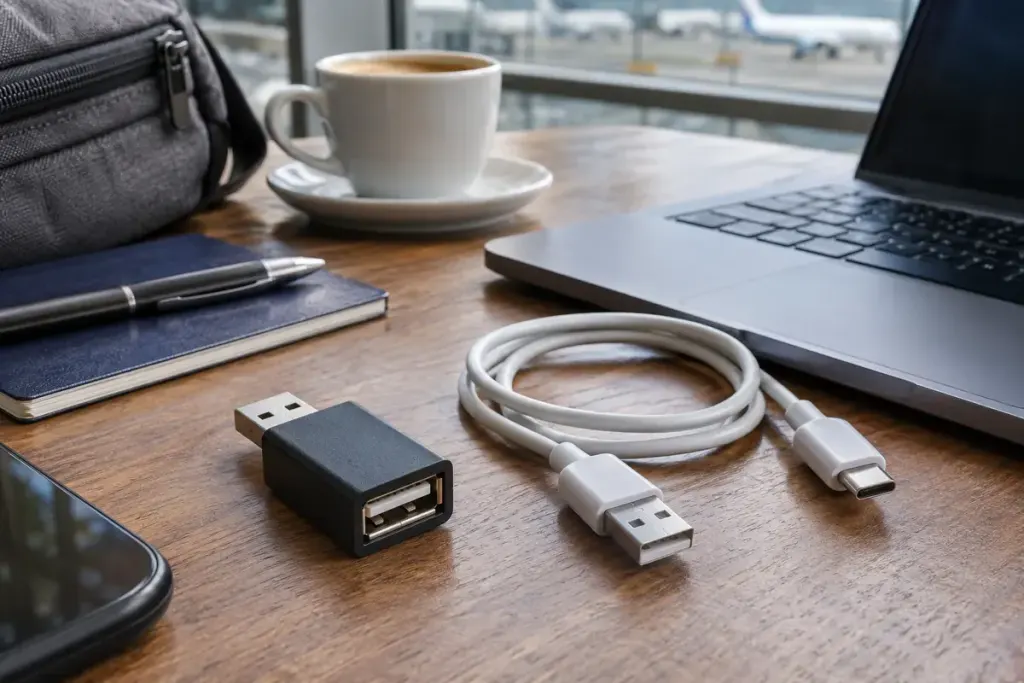
A USB data blocker is intended to let a device receive power while preventing ordinary data transfer through the connection it supports. It is a narrow-purpose accessory. The words “data blocker” do not tell you everything about electrical quality, charging speed or compatibility.
For example, StarTech’s documentation for its USBSCHAAMF adapter identifies a USB-A charge-only, no-data product. That description applies to that model. It does not establish that an unfamiliar adapter with a similar shape has the same construction or capabilities.
Check the connection you actually have
Write down the port at the power source, the cable connectors and the device’s charging requirements. USB-A and USB-C accessories are not interchangeable merely because both belong to the USB family. A chain of adapters can make it harder to understand what is connected.
Read the manufacturer’s supported charging specifications. Do not assume that an accessory will preserve every fast-charging mode available with the original cable and charger. Equally, a slower charge does not by itself prove that data blocking is functioning correctly.
A practical home check
Before relying on an accessory during travel, use it with your own known equipment. Confirm that the connectors fit without force and that the device charges as expected. Keep the model information so you can consult the documentation later. A successful charge is a compatibility observation, not a laboratory security certification.
Consider the broader setup too. A data blocker does not secure a compromised phone, make an untrusted mains charger electrically safe, or protect unrelated wireless connections. Those claims would require entirely different evidence.
For an ordinary trip, a reputable charger or power bank you control may keep the setup simpler. If you choose a data blocker for a particular situation, make that purpose explicit: reducing data connectivity through a specified charging connection. A precise expectation is more useful than assuming a small adapter makes every kind of public charging risk disappear.